It's a science-backed, barbell-based workout that uses high-repetition compound movements to build strength and sculpt lean muscle across your entire body. In Les Mills BodyPump classes you follow coached, music-driven tracks and progressive loading to improve muscular endurance, posture and metabolic conditioning; you can scale weights and technique to match your goals and experience level.
Key Takeaways:
- High-repetition barbell-based resistance sessions build muscular endurance and full-body toning while allowing progressive strength gains by increasing weight.
- Structured, music‑driven class format targets all major muscle groups in about 45-60 minutes, combining compound lifts for efficient calorie burn and lean muscle development.
- Controlled tempo and emphasis on technique minimize injury risk and support improvements in posture, functional strength, and bone health.
Overview of BodyPump
Typically a 55-minute, barbell-based class, BodyPump combines 10 music-driven tracks that target chest, back, legs, shoulders, arms and core with high-repetition sets (about 800 reps per session). You can scale loads to your level, follow quarterly choreography updates, and expect a program focused on muscular endurance and full-body toning; see the program details at Les Mills BodyPump.
History of the Program
Developed by Les Mills International in New Zealand during the 1990s, BodyPump evolved from a club-based barbell class into a standardized global format in the early 2000s. You’ll find the instructor-training model and frequent music/choreography updates were central to scaling the format into commercial gyms and on-demand platforms worldwide.
Key Benefits
You get improved muscular endurance, whole-body toning, and a strong metabolic stimulus from the high-rep, low-load structure; typical sessions burn roughly 300-500 kcal depending on your size and effort. Many participants also gain barbell confidence because you progress in small plate increments and rehearse compound patterns repeatedly.
For measurable results, attend 2-3 classes per week for 8-12 weeks to see endurance and modest strength gains; track the weight used on each track to apply progressive overload. Pairing BodyPump with one heavy compound lift per week (squat or deadlift) and regular mobility work speeds strength development and helps prevent imbalances from repetitive sequencing.
Structure of a BodyPump Class
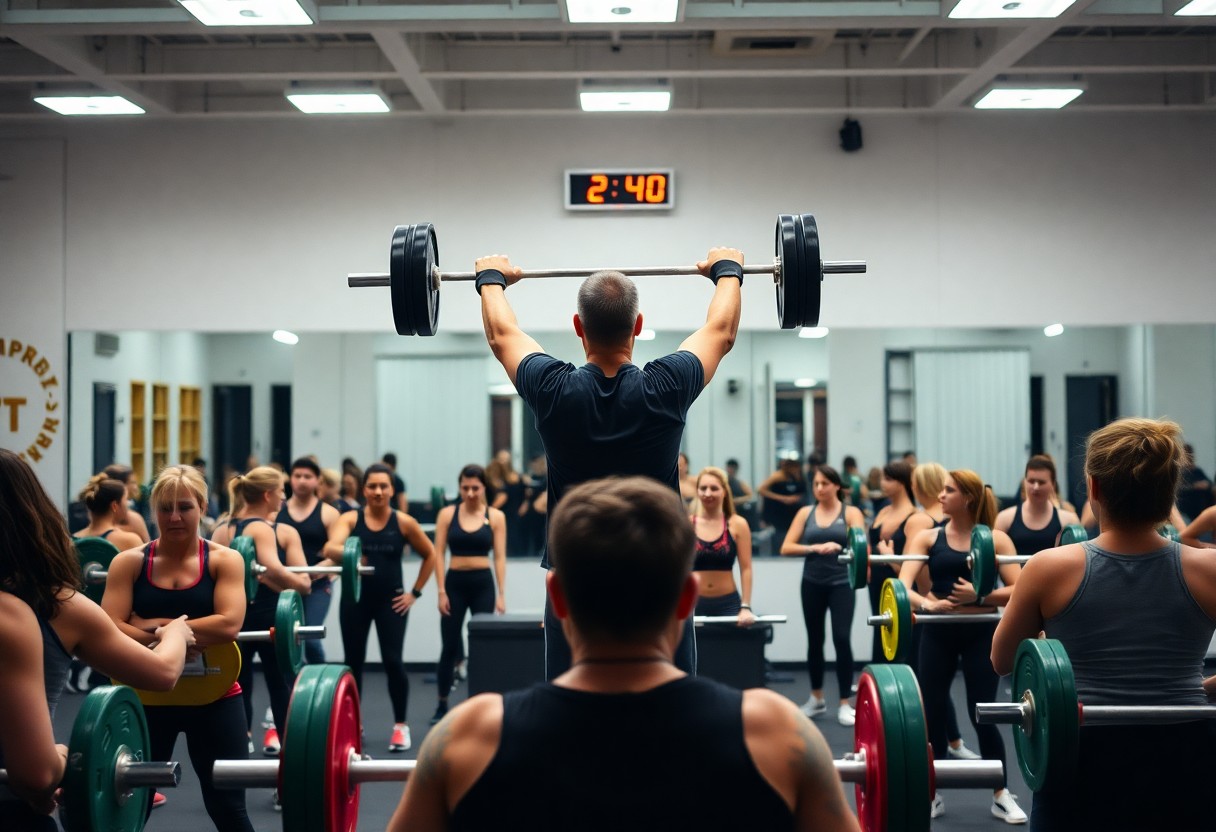
You progress through a tight, music-driven format built around 10 tracks that isolate major muscle groups and blend endurance with tempo-based strength work. Sessions use high-repetition sets-often 50-100 reps per track-short transitions, and coach-led cues to keep intensity steady. Expect a predictable flow that balances compound lifts (squats, deadlifts) with targeted tracks (chest, shoulders, core) to maximize total-body conditioning in about 55 minutes.
Typical Class Format
You begin with a warm-up track, then move through squats, chest, back, triceps, biceps, lunges, shoulders, core, and finish with a cool-down; instructors often swap track order slightly for choreography updates. Tracks commonly last 3-6 minutes with minimal rest between them, and coaching focuses on tempo, range of motion, and safe plate changes so you maintain form across high-rep sets.
Equipment Used
You use a group fitness barbell, weight plates, collars, and a mat; some classes also provide steps or benches for lunges. Plates typically come in small increments-0.5-2.5 kg-up to 20 kg, letting you make fine load adjustments for each track. Bar grips and rubber-coated plates speed transitions and reduce noise in studio settings.
You should tailor load selection by track: load heavier for squats and deadlifts, moderate for chest and back, and lighter for shoulders and core. Practical progression is adding 1.25-2.5 kg per side as you get stronger; beginners often start with total loads around 10-25 kg, while experienced participants may use 40-60+ kg for compound tracks, always prioritizing controlled tempo and full range of motion.
Muscle Groups Targeted
Across a 60‑minute Les Mills BODYPUMP class split into roughly 10 tracks, you hit all major muscle groups: chest, back, shoulders, biceps, triceps, quads, hamstrings, glutes, calves and core. Compound moves - squats, deadlifts, presses and rows - drive high‑rep, moderate‑load work that builds muscular endurance and full‑body tone while improving joint stability and posture.
Upper Body Strengthening
During upper‑body tracks you perform chest presses, bent‑over rows, overhead presses, biceps curls and triceps extensions, typically in 10-30 rep sequences. Focus your tempo and form; progressive overload in 1-2.5 kg increments helps you increase muscle endurance and visible toning. Coaches often recommend lighter weights with higher reps to emphasize time under tension and shoulder stability.
Lower Body Toning
Leg tracks concentrate on squats, lunges, deadlifts and hip thrusts to target quads, hamstrings, glutes and calves, and they usually demand heavier loads than upper‑body tracks. Expect more single‑leg and compound variations; the added mechanical load drives shape and strength improvements in the posterior chain and thigh musculature.
To progress, increase load by 2.5-5 kg once you can complete a full track with flawless form, and incorporate unilateral moves like Bulgarian split squats to correct imbalances. Apply a controlled tempo (about 3 seconds down, 1 second up) and train legs 2-3 times weekly; with consistent sessions and ~1.6 g/kg protein intake you’ll typically see strength and muscle‑tone gains in 6-8 weeks.
Nutrition and BodyPump
To maximize your BODYPUMP gains, dial in calories, macronutrients and timing: aim for 1.2-2.0 g/kg protein daily, 3-6 g/kg carbohydrate depending on session volume, and fats around 20-30% of calories. Prioritize whole foods-lean proteins, whole grains, fruits and vegetables-and hydrate with 500-750 ml in the two hours before class plus sips during workouts. Proper fueling supports endurance across 10 tracks and faster recovery between sessions.
Importance of Nutrition for Strength Training
You need protein to drive muscle protein synthesis; consuming 20-40 g of high-quality protein after sessions shifts net protein balance positive, supporting repair and hypertrophy. Glycogen fuels repeated sets, so top up with 0.5-1.0 g/kg carbohydrates pre- or post-workout to maintain intensity. Micronutrients like iron, vitamin D and calcium also influence energy production and recovery, so track them alongside macros.
Recommended Diet for BodyPump Participants
Before class eat 1-2 hours prior a meal with 30-60 g carbohydrates and 15-25 g protein; if you have only 30-60 minutes choose 20-30 g fast carbs plus 15-20 g protein. Post-workout target 20-40 g protein with 30-60 g carbs within an hour to replenish glycogen and stimulate repair. For daily intake, aim 1.2-2.0 g/kg protein and adjust calories to fat-loss, maintenance or muscle-gain goals.
Sample day: Breakfast-50 g oats with 1 scoop whey (≈25 g protein) and berries; Lunch-150 g grilled chicken (≈35 g) with 1 cup cooked rice; Pre-class snack-banana and 150 g yogurt; Post-class-whey shake (25-30 g protein) plus a sandwich or rice; Dinner-120-150 g salmon with sweet potato and greens. Scale portions to your bodyweight and training frequency.
Tips for Beginners
When you begin BodyPump, prioritize consistency and technique over heavy plates: aim for 2 classes per week for the first 4-8 weeks to build endurance and motor patterns, use small plate increments (0.5-2.5 kg) so you can maintain controlled tempo across all tracks, and scale back if form breaks in the last two sets; track loads each session and ask the instructor for targeted form checks.
- Arrive 10-15 minutes early to set up your bar and plates.
- Tell your instructor about injuries or mobility limits before class.
- Start with an unloaded or lightly loaded bar during the warm-up.
- Log weights per track so you can progress incrementally over weeks.
Finding the Right Class
Look for classes labeled "Foundations," "Intro," or beginner-friendly BodyPump sessions at your gym, and consider workshops; LES MILLS issues new releases roughly every 3 months, so newer releases often include clearer coaching cues-try 2-3 different instructors over a month to find pacing, cue style, and class size (commonly 15-40 participants) that suit your learning pace.
Common Mistakes to Avoid
Avoid loading too heavy (adding more than 2.5-5 kg when you lose control), gripping the bar so tight it disrupts wrist alignment, rounding your lower back on deadlifts, and locking knees during squats; skipping warm-ups, ignoring tempo cues, and failing to track weights are frequent habits that stall strength and increase injury risk.
For corrective steps, practice hinge and squat patterns with an unloaded bar or PVC pipe and reduce load by 5-15% if you feel form break; use a mirror or quick instructor check to ensure neutral spine and elbows/shoulders move with controlled tempo (2 seconds concentric, 2 seconds eccentric), and only increase weight after two consecutive classes where you complete all reps with solid technique.
Advanced Techniques and Variations
You can layer targeted strategies like tempo changes, drop sets and unilateral work to push strength and hypertrophy within the BodyPump format; applied correctly these techniques let you shift from endurance-focused 15-30 rep tracks toward heavier, strength-oriented stimuli without altering class choreography.
- Tempo manipulation - slow eccentrics (3-5s) to increase time under tension.
- Drop sets - reduce 20-50% load mid‑track to extend sets past failure.
- Supersets/compound sets - pair antagonist or same-muscle exercises for density.
- Unilateral progressions - single-leg RDLs, split squats to fix imbalances.
- Cluster/rest-pause - brief 10-20s rests to accumulate heavy reps.
- Negatives and partials - overload the eccentric or lockout portions for strength.
Technique vs Application
| Technique | How to apply (example) |
|---|---|
| Tempo manipulation | Use 3‑0‑1 on squats for 8-12 reps within a 15‑rep track to increase TUT by ~30-40s. |
| Drop sets | After reaching failure at 25 reps, remove 20-30% plate mass and continue 10-15 reps. |
| Unilateral work | Swap bilateral lunges for single-leg RDLs with 5-10 kg dumbbell to target stability and strength. |
| Cluster reps | Perform 3×(4 reps, 12s rest) at a heavier load to hit strength ranges inside the class. |
Increasing Intensity
You should progress by small, measurable steps: increase bar load ~2.5-5% (≈1.25-2.5 kg plates) for upper‑body tracks and ~5-10% for lower‑body across 2-4 week blocks, or raise RPE by 0.5-1 while keeping form; alternatively add tempo changes, extra reps, or reduce intra‑track rest to boost workload without changing class selection.
Modifying Exercises
You can regress or progress exercises to match capacity and goals: substitute barbell chest press with dumbbell presses for unilateral balance, replace back squats with goblet squats to reduce spinal load, or scale load by 30-50% for rehabilitation while maintaining movement patterns.
For practical programming, alternate progressive and recovery weeks (e.g., 3 weeks build, 1 week deload), use unilateral variations to correct strength asymmetries (track left/right loads separately), and apply tempo prescriptions-slow eccentrics for hypertrophy (3-4s) or faster concentric emphasis for power-to align BodyPump sessions with a 8-12‑week strength or toning cycle.
To wrap up
Hence you can use Les Mills BodyPump to build strength, increase muscular endurance, and tone your whole body through structured, coach-led sessions; by focusing on progressive loads and proper technique you will see measurable gains and reduced injury risk - try Les Mills BodyPump™ at the YMCA of Greater Cleveland for guided workouts and community support.
FAQ
Q: What is the Les Mills BodyPump workout and how does it build strength and full-body tone?
A: BodyPump is a barbell-based group fitness class that uses light-to-moderate weights with high-repetition sets timed to music. Each session targets all major muscle groups through a standardized track list (warm-up, squats, chest, back, triceps, biceps, lunges, shoulders, core, cooldown). The high-rep format develops muscular endurance, increases time under tension for muscle shaping, and elevates metabolic rate for fat loss-combined effects produce leaner, more defined musculature rather than maximum single-rep strength.
Q: How often should I do BodyPump to see strength and toning results?
A: For general toning and improved muscular endurance, 2-3 BodyPump sessions per week is effective. To accelerate strength and hypertrophy, pair BodyPump with 1-2 sessions of heavier, lower-rep resistance training per week or progressively increase weights within BodyPump while maintaining form. Allow at least one full rest or active recovery day between intense sessions to support muscle repair and adaptation.
Q: What equipment and technique should I use to be safe and effective in BodyPump classes?
A: Use a barbell with collars, plates sized to your current capacity, non-slip flooring, and a bench or step when required. Prioritize form: neutral spine, knees tracking over toes, controlled tempo (no bouncing), full but comfortable range of motion, and steady breathing. Select weights that let you complete most reps with effort on the last few reps while maintaining technique. Ask an instructor to check your setup and form; scale weight down if you cannot maintain proper positions.
Q: How can beginners and advanced exercisers adapt BodyPump workouts?
A: Beginners should start with the empty or light bar, focus on mastering technique, reduce plate load on demanding tracks, and use slower tempos or partial ranges if mobility is limited. Advanced exercisers can increase weight incrementally (microloading), challenge tempo by adding pauses or slower negatives, incorporate unilateral variations during warm-ups or supplemental sessions, or combine BodyPump with heavier compound lifts outside class to build maximal strength while maintaining endurance and tone.
Q: How does BodyPump compare to traditional strength training and what realistic results and timeline can I expect?
A: BodyPump emphasizes high reps and muscular endurance, producing lean, toned muscles and improved conditioning. Traditional strength training (low reps, heavy loads) is better for maximal strength and larger muscle hypertrophy. Expect improved muscle tone and endurance within 4-8 weeks of regular BodyPump; noticeable strength increases and body-composition changes often appear in 8-12 weeks when paired with progressive overload, adequate nutrition (sufficient protein and calories), and proper recovery.



.jpg)


0 Comments